
Book publication: Language, Knowledge and Society in Higher Education
Ian Bruce and Alex Ding
Publication date 22nd January 2026
There is already an inordinate number of publications focusing on academic communication, what possible value is there in us adding to an already very crowded market? This is the question we posed at the beginning of our book. After all, it really is not that obvious what else needs to be said or read about academic communication that hasn’t already been said or becomes simply a trivial addition. Our response to this acts as our motivation, rationale, and conviction for writing this book and marking what we hope is our unique, valuable, and heterodox (and possibly heretical) contribution.
We noted that despite receiving intense scrutiny over a now substantial period of time, existing established strands of research on academic communication tend to focus only on a narrow and one-dimensional aspect of academic communication to the detriment of a holistic approach that can capture the multiple dimensions of academic communication and inform and contribute to a comprehensive understanding. One that is both broader and deeper than any one strand currently offers or advocates. We stress throughout our book the limiting and limited ways in which these three dimensions have been addressed in research. Through a focus on singularity, the various research strands have failed to examine academic communication in its highly complex and multifaceted nature. Currently, we have a highly partial, fragmented, and atomistic knowledge-base on which to make sense of academic communication.
In order to redress the fragmentation of research on academic communication we not only critique existing research and argue for holism, but we also and more importantly propose an operationalizable model for academic communication (figure below).
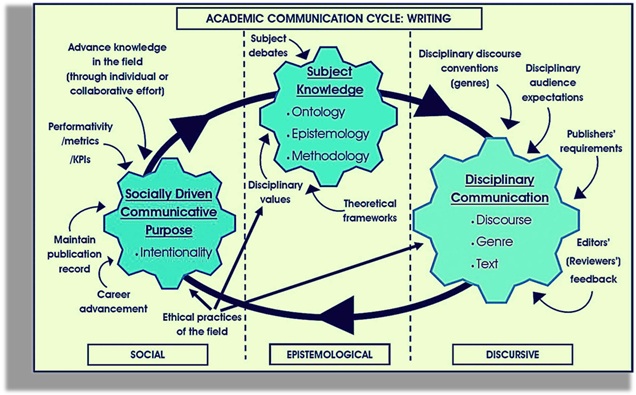
The genesis of this book can be found in our 2017 book The English for Academic Purposes Practitioner: Operating on the Edge of Academia where we first mentioned these three dimensions. In many ways we have been thinking, reading and writing for our current book since 2017. Inspired by a short chapter written by Ferguson in 1997, we argue that a holistic understanding of academic communication entails capturing and integrating social, epistemological and discursive dimensions. Only then can we claim to have specialised knowledge of academic communication. All three dimensions are explored fully and deeply throughout the book.
We are aware that this claim is provocative and likely to solicit hostility (assuming of course that academics still read books) but we have taken great care to substantiate this critique, and our motivation is not critique per se, rather it is a means of ground clearing to establish our own model of academic communication.
In addressing this fragmentation, which is our main goal in this book, we drew inspiration from Bhaskar’s critical realism and especially his notion of transcendental argument, which is an approach to reasoning, in this case applied to academic communication, that attempts to identify the necessary conditions that make certain features of human experience possible. This led us to the central question that animates the whole book:
What are the conditions of society, its approaches to knowledge, and its uses of language that influence and enable academic communication?
No single theory or method can help us answer this and we drew on a very wide range of sources and ideas to think with and think against. Alongside Bhaskar, Bourdieu was particularly useful especially his tools of field, capital, habitus, illusio and doxa. We engaged deeply too with political and economic theory, ethics, epistemology and read (with and against) a number of writers including Feyerabend, Derrida, Foucault, Latour, Lakatos, Popper, Kuhn and Husserl. Not surprisingly, applied linguists feature throughout, including Martin, Swales, Hyland, Widdowson, and importantly Van Dijk. Ian’s career spanning interest in text discourse and genre theory is also very present in the book. Writing this book was an intellectual challenge, involving us both in reading very widely and deeply across multiple disciplines and involved many many lengthy and stimulating discussions between us.
We hope that this book – to counteract the forces that fragment, splinter and parochialise research and ultimately distort research on academic communication – offers a way out through an emphasis on holism and a much more accentuated and collective reflexivity within communities that research, teach and use academic communication to help us all better understand the complexities of academic communication. Our heterodox and heretical view is that continuing as normal will stifle and deaden research in increasingly obtuse and isolated academic silos.
Finally, we received two very nice endorsements (see below). It would appear that they haven’t read the same book. We think or hope the book is of value on both accounts and we hope you too find something useful.
A comprehensive, insightful, and far-reaching account of academic communication that offers a multiperspective and at the same time, a multidimensional view of how to integrate genre, disciplinary culture and actual practice, adding a unique perspective to a bourgeoning literature in the field.
Vijay K Bhatia, City University of Hong Kong, China
In this era of increasing precarity with ongoing neo-liberalizations of universities echoing the broader capitalist society causing detrimental rises of stress and alienation among educators and students due to marketizations of standardized education, this book brilliantly addresses how academic communication is being manipulated and distorted to prevent truthful knowledge.
Christian W. Chun, Associate Professor, University of Massachusetts Boston, USA